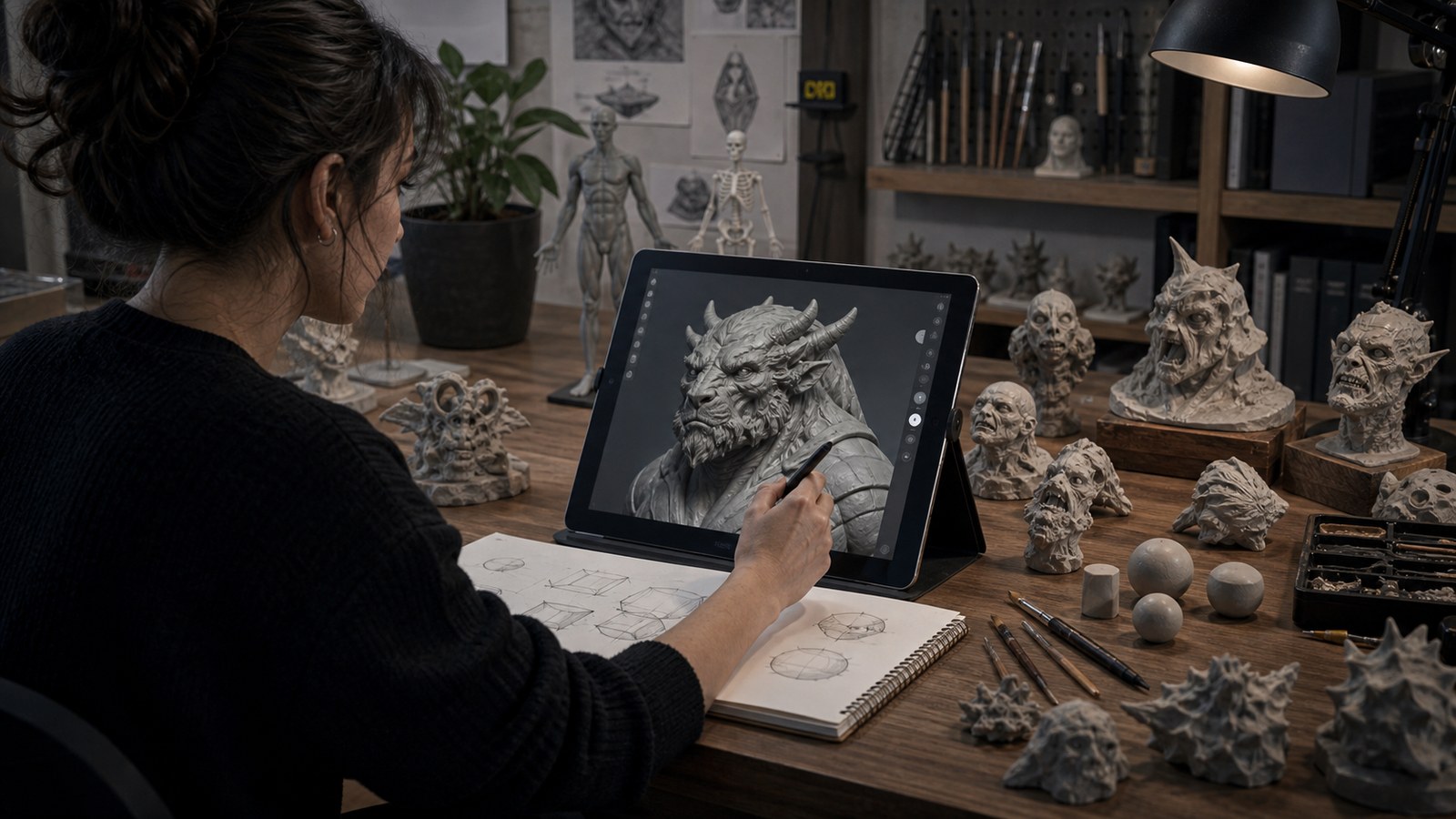
Becoming a 3D modeler has never been more exciting or more accessible. Once limited to major film studios and large gaming companies, 3D modeling has evolved into a global creative field where artists build everything from animated characters to architectural landscapes to product prototypes. Whether you dream of designing vivid game worlds, sculpting creatures for blockbuster movies, or creating sleek, photorealistic product renders for major brands, 3D modeling offers endless opportunities for those who enjoy combining imagination with technical precision. This guide walks you through the skills, tools, workflows, and career paths that shape the world of 3D modeling and shows you how to build the foundation for a long, rewarding creative journey.
A: No. Many professionals are self-taught or come from bootcamps; a strong portfolio matters more than a diploma.
A: With focused practice, many artists build a competitive portfolio in 1–2 years, sometimes faster.
A: Blender is a powerful free option; Maya and 3ds Max are common in studios. Choose one and master it.
A: Drawing helps with design and anatomy, but you can develop those skills alongside your 3D modeling practice.
A: Only your best work: clean models, good topology, strong materials, and polished renders that match your desired niche.
A: Specializing (characters, environments, hard-surface) makes you easier to hire, but early on it’s fine to experiment broadly.
A: Yes. Many studios and clients hire remote artists, especially for freelance and contract roles.
A: Very. Sharing your work online, joining communities, and connecting with other artists often leads to job opportunities.
A: Choose the field that excites you most; each has different workflows, but core modeling principles carry over.
A: Break goals into small wins, track improvement over time, and remember that every model is a step toward mastery.
What 3D Modeling Actually Is
3D modeling is the art and science of creating digital representations of objects, characters, structures, and environments. These models come to life through shapes, surfaces, textures, materials, and lighting that collectively turn polygons into believable virtual forms. Unlike 2D art, where you work with flat shapes, 3D modeling allows you to build and manipulate objects in full dimensional space, giving your creations depth, volume, and the ability to exist from any angle.
In film and games, 3D models are used to animate characters, populate backgrounds, and construct entire digital worlds. In product design, they help engineers refine prototypes before anything physical is manufactured. In architecture, models give clients a realistic glimpse of buildings long before construction begins. The universal need for visualization has made 3D modeling a foundational skill across industries.
Why 3D Modeling Has Become a High-Demand Career
The demand for 3D modeling has expanded dramatically as digital experience has become central to entertainment, branding, education, advertising, and simulation. Streaming platforms need high-quality animated content. Game studios produce larger, more immersive worlds every year. Companies developing augmented reality and virtual reality rely on 3D assets to build interactive experiences. Even fields like medical research, manufacturing, and scientific visualization use 3D modeling to communicate complex ideas. This surge in demand means 3D modeling careers are accessible at many skill levels. Entry-level modelers build props and environment pieces. Experienced artists create characters, weapons, vehicles, and architectural structures. Senior modelers specialize in technical workflows or lead entire departments. Whether you prefer realistic detail, stylized worlds, or industrial design, the field allows you to carve out your own niche.
The Artistic Foundations Every Modeler Needs
Many beginners assume that 3D modeling is purely technical, but great 3D modelers always think like artists first. Understanding shape, proportion, silhouette, and visual flow is just as important as mastering software. Even the most advanced modeling tools cannot compensate for weak fundamentals.
A strong foundation starts with learning how to observe. Study how light interacts with surfaces. Train your eye to recognize curves, planes, symmetry, and structure. If you are modeling characters, understanding anatomy is essential; it helps you create believable posture, rhythm, and gesture. If you plan to model props, vehicles, or architecture, understanding real-world construction and surface details will help you create convincing assets. These artistic foundations become the backbone of every model you build, no matter how stylized or fantastical your creative vision may be.
Understanding Different Types of 3D Modeling
3D modeling is a broad field with several specialized disciplines. Beginners often start with one and gradually explore others as their skills grow. Polygonal modeling focuses on working with vertices, edges, and faces, making it ideal for game assets and hard-surface objects like vehicles or weapons. Digital sculpting simulates the experience of working with clay and is ideal for organic subjects such as creatures, humans, animals, and high-detail surfaces.
Procedural modeling uses rule-based systems that automatically generate complex structures, making it popular in architecture, environments, and visual effects. Curve-based and subdivision modeling help create smooth, clean shapes used in animation, industrial design, and automotive modeling. By understanding the strengths of each modeling approach, you can choose the path that best matches your creative goals.
The Tools You Need to Begin
You don’t need expensive hardware or high-end software to become a 3D modeler. Many powerful tools are free or budget-friendly, and most professional studios value skill over software. Blender, for example, is a free open-source 3D suite with modeling, sculpting, animation, and rendering tools that rival industry standards. Maya, 3ds Max, and Cinema 4D are widely used in film and gaming for character and environment modeling. ZBrush is the gold standard for digital sculpting, providing unparalleled control over organic forms. Beyond software, a basic computer with a decent graphics card can handle most beginner projects. A pen tablet can make sculpting and texturing more intuitive, but it’s not required at the start. As you grow, you may upgrade your tools to match your workflow, but your creativity—not your equipment—will always be the driving force.
Learning the Process: From Concept to Finished Model
Every model begins with an idea. Sometimes it’s a sketch, a mood board, a 2D illustration, or a written character description. Concept art acts as the blueprint, guiding your modeling decisions and helping you maintain visual consistency throughout the project. The modeling process typically begins with a blockout—a simple, low-resolution version of the model that defines major shapes and proportions without detail. This step is crucial because it gives you the structure needed to avoid mistakes later. After the blockout, you refine the model by sharpening shapes, smoothing edges, defining curvature, and adding the structural elements that make the form visually clear.
For organic models, the refinement stage often involves multiple passes in a sculpting program before transferring the sculpt into a topology-friendly layout suitable for animation. For hard surfaces, refinement may involve adding bevels, trims, panel lines, and mechanical details that give the asset purpose and realism. Once the shapes are correct, you add surface detail, textures, materials, and color, transforming the raw model into a polished, visually complete asset. The final step is rendering—showcasing your model with lighting that highlights its shape, detail, and personality.
Mastering Texturing and Materials
Texturing and shading bring your models to life. Even the most perfectly shaped model will feel incomplete without convincing surface qualities. Texturing involves painting or mapping color, roughness, specular highlights, and surface imperfections onto your model. Programs like Substance Painter, Mari, and Quixel Mixer give artists precise control over materials, allowing them to create everything from worn metal to polished marble to detailed skin. Understanding how materials behave in the real world makes your textures more believable. Metals reflect light differently than fabric. Subsurface scattering affects how light moves through skin. Rough surfaces disperse light, while glass and water bend it. Learning to mimic these characteristics takes practice, but it dramatically improves your final results.
Animation-Ready Modeling and Topology
If your models are intended for animation or gaming, understanding topology is essential. Clean topology ensures that deformation—movement of joints, facial expressions, cloth movement—behaves naturally. Good modelers create loops around eyes, mouths, elbows, and knees to support predictable bending. Even stylized characters benefit from clean topology because it keeps animation smooth and efficient.
Retopology, the process of rebuilding a dense sculpt into an optimized, animation-friendly mesh, is a standard step in many pipelines. Tools like Blender’s RetopoFlow, Maya’s Quad Draw, and ZBrush’s ZRemesher help artists create clean geometry that balances detail with performance requirements.
Rendering and Presentation: Showing Your Work Like a Professional
Rendering transforms your 3D model into a final image or animation, with lighting and camera setups that emphasize its best qualities. Rendering engines like Cycles, Arnold, Redshift, Octane, and V-Ray allow artists to simulate realistic lighting, reflections, shadows, and materials. Understanding different lighting types—three-point lighting, rim lighting, HDRI setups—helps you present your model in a way that feels cinematic and polished. A great model presented poorly will never look professional. Good presentation can elevate your work dramatically, making it feel studio-ready even if you are still learning. Most modelers create multiple renders, including close-ups, turntables, wireframes, and beauty shots, to communicate the full scope of their skill.
Building a Portfolio That Attracts Employers
A strong portfolio is your most powerful tool for breaking into the industry. Studios look for clean topology, good form, believable textures, and consistent visual style. You don’t need dozens of pieces; five to ten exceptional models can open doors far faster than twenty average ones.
Your portfolio should reflect your specialization. If you want to model characters, focus on expressive, well-structured anatomy. If you want to build environments, create several mood-rich scenes that showcase storytelling. If props or hard-surface items interest you, build a collection of functional, detailed, polished assets that demonstrate mastery of form and material. Your portfolio is also a reflection of your artistic voice. As you grow, your visual identity becomes clearer, setting you apart from thousands of other modelers.
How to Practice Effectively
Improving as a 3D modeler requires deliberate, consistent practice. Beginners often rush to create large, complicated scenes, but mastery begins with small, focused studies. Sculpt a single creature head. Model a stylized prop. Rebuild a real-world object from reference photos. These exercises sharpen your understanding of form, proportion, and detail without overwhelming you. Studying real objects strengthens your observational skills. Reverse-engineering professional 3D models teaches you new workflows. Following tutorials builds technical understanding, while personal projects push your creativity. The combination of structured study and creative exploration results in steady, meaningful progress.
Choosing Your Modeling Specialization
3D modeling is a vast field with many paths, and choosing a specialization helps you build expertise that employers value. Character modeling attracts artists who enjoy anatomy, expressive faces, costumes, and personalities. Creature modeling appeals to those who love merging realism with fantasy, creating imaginative beings with believable biology.
Environment modeling focuses on landscapes, interiors, architecture, and props, making it popular among world-building enthusiasts. Hard-surface modeling is ideal for artists drawn to vehicles, weapons, robotics, and mechanical objects. Product visualization and industrial modeling cater to designers who want to bring physical objects to life through digital prototypes. You don’t need to choose your specialization immediately. Early in your journey, exploring different categories helps you discover your strengths and passions.
Career Paths in the 3D Modeling Industry
The career opportunities for 3D modelers span across entertainment, design, and technology. In video game studios, modelers create characters, props, weapons, vehicles, and environmental assets. In film and animation, they craft high-detail models for creatures, sets, and digital doubles. VFX houses rely on modelers to build photorealistic assets that integrate seamlessly with live-action footage.
Architectural visualization firms use 3D modelers to create interior designs, building concepts, and photorealistic walkthroughs. Product design companies depend on 3D modeling for prototyping, branding, and advertising. Even emerging fields like medical simulation, AR/VR development, and training simulations rely on 3D assets.
Some modelers work in-house with large teams; others build freelance careers, offering modeling services to studios, agencies, or private clients worldwide. Remote 3D modeling work has become especially common, allowing artists to collaborate internationally.
How to Break into the Industry
Breaking into the world of 3D modeling requires a mixture of skill, networking, and persistence. Your portfolio does the heavy lifting, but the relationships you build amplify your opportunities. Online communities, art stations, forums, and social platforms let you share your work and learn from professionals.
Many artists get their first opportunities through internships, mentorships, game jams, film projects, or collaborative indie games. Others build a presence online and attract freelance clients. Staying active, improving consistently, and showing your passion for the craft is often what separates those who break in from those who give up too early.
Staying Relevant in a Rapidly Changing Industry
3D modeling is a field that evolves quickly as tools improve and new technologies emerge. AI-assisted workflows, real-time rendering, GPU advancements, and procedural modeling systems are reshaping the way artists work. Staying curious ensures that you remain adaptable in an ever-changing landscape. Experienced modelers continuously learn new tools, workflows, and industry trends. They study the work of other artists. They embrace experimentation. They push boundaries. This mindset keeps them competitive, relevant, and creatively fulfilled.
Where Your 3D Journey Can Take You
Becoming a 3D modeler opens doors to countless creative paths. You can help build immersive video games, design characters for animated films, craft futuristic vehicles for science fiction worlds, visualize buildings that don’t yet exist, or create product concepts that shape the future of technology. You can freelance, join a studio, teach others, or launch your own creative brand.
The beauty of 3D modeling lies in its limitless potential. Every new project becomes an opportunity to learn, grow, and bring something extraordinary into existence. Whether your dream is to work on Hollywood blockbusters or build imaginative indie projects, your journey begins with curiosity, practice, and the willingness to turn passion into skill.