Bringing Digital Life Into Form
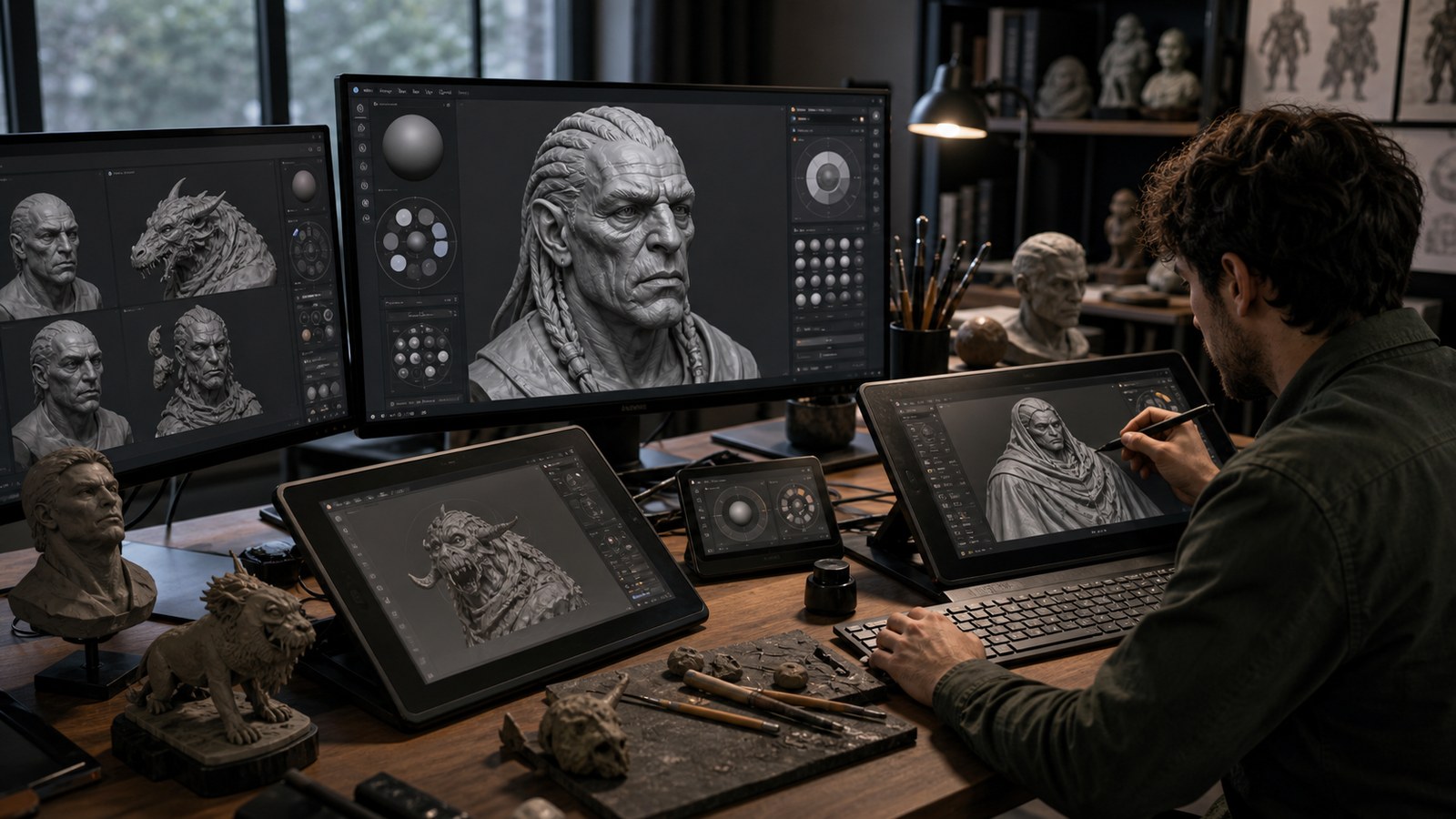
Character sculpting is one of the most challenging and rewarding artistic pursuits in the digital world. To sculpt a realistic character is to translate anatomy, emotion, personality, and story into three-dimensional form. It requires a mastery of technique, but also the sensitivity of an illustrator, the curiosity of a researcher, and the intuition of a storyteller. Every pore, wrinkle, and plane contributes to the illusion of life, and every shaping decision has consequences for animation, shading, and the viewer’s emotional response. In the professional pipeline—film, games, cinematics, collectibles, and digital doubles—realistic character sculpting follows a structured yet flexible workflow. This workflow blends foundational art principles with advanced digital techniques, creating a systematic path from the first shape to the final rendered figure. In this breakdown, you’ll explore the exact steps professionals use to sculpt high-end, believable characters that hold up under extreme close-ups and demanding production environments.
A: Skill and observation matter far more. Any modern sculpting software can support a pro-level workflow.
A: Enough to understand bone landmarks, muscle flow, and fat distribution. The deeper your knowledge, the stronger your sculpts.
A: Basemeshes speed up production, but occasionally starting from primitives sharpens your fundamentals.
A: When the sculpt clearly communicates the intended story, holds up at multiple distances, and extra detail adds little value.
A: Vary your surface breakups, add asymmetry, and study real skin behavior under light instead of relying on uniform noise.
A: A neutral base is useful for rigging, but subtle expression passes can make your portfolio pieces far more engaging.
A: A few highly polished, fully realized characters are more impressive than many unfinished or rushed pieces.
A: Reference is essential at every level; memory alone introduces errors and generic features.
A: Scans are tools; your value comes from how you clean, enhance, and direct them toward a specific design goal.
A: Do regular focused studies—heads, hands, faces, and expressions—paired with honest critique and real-world reference.
The Foundation of Realism: Understanding the Human Machine
Before any digital sculpting begins, artists immerse themselves in the study of anatomy, proportions, and human variation. Realistic sculpting is fundamentally observational. Sculptors analyze skeletal landmarks, muscle origins and insertions, fat distribution, facial planes, and the micro-variations that make characters feel human. Professionals often build or reference extensive anatomy boards filled with medical diagrams, real photography, and 3D anatomy models.
But technical understanding isn’t enough. Real humans are asymmetrical, uniquely flawed, and deeply expressive. A character’s realism comes not from perfection, but from the subtle irregularities that make each face and body distinct. A slightly curved septum, uneven eyelids, a shifted smile line—these micro-asymmetries create believability. Professional sculptors develop an instinct for recognizing these nuances and integrating them intentionally into their work.
A Professional Mindset: Starting with Intent, Story, and Identity
Every realistic character begins with a simple but profound question: Who is this person?
Even if the sculpt is for practice, defining an identity shapes every modeling decision. The character’s age, health, lifestyle, environment, and personality affect their musculature, posture, wrinkles, scars, and facial structure. An elderly traveler may carry sun-worn skin and pronounced folds; a disciplined soldier may have hardened planes and strong posture; a fantasy healer might display soft forms with gentle, calm expressions. Professionals develop this narrative before touching a brush. The character’s story determines the sculpt’s direction, creating a cohesive and emotionally resonant final result.
The Blockout Stage: Sculpting the Essence Before the Detail
The blockout is the soul of the sculpting process. At this stage, artists focus exclusively on shape, proportion, and silhouette. No pores. No wrinkles. No micro-detail. Just the core structure. Using basic primitives or a basemesh, sculptors define the ribcage volume, pelvis tilt, shoulder rhythm, skull shape, and major masses. They check the pose—even a neutral stance has attitude. The blockout must feel alive and balanced, with weight distribution that makes physical sense. Professionals constantly rotate the model, squint their eyes, and evaluate the sculpt from a distance to judge the readability of form. They also flip between different lighting setups to reveal hidden issues. A strong blockout simplifies the rest of the workflow and prevents hours of backtracking in later phases.
Refining Secondary Forms: The Sculpt Begins to Breathe
Once the blockout is solid, artists move into the secondary forms phase. Here, the sculpt begins to take on anatomical realism. Muscles are defined, but not over-pronounced. Fat pads are shaped, transitions softened, and major plane changes introduced.
This stage is where the sculpt “breathes.” The character gains structure, clarity, and presence. Professionals pay close attention to tension areas—around the mouth, eyes, and hands—along with the broad curvature of the torso, limbs, and digits. Secondary forms make a character feel physically coherent and grounded in real anatomy. Without this stage, detail applied later looks artificial and unconvincing.
Building the Face: The Most Critical Territory
Realistic character sculpting lives or dies in the face. The face communicates personality, emotion, and the essence of the character. Sculptors treat it with extraordinary care, beginning with the skull structure before layering muscles, fat pads, and final forms. They constantly measure proportions, even if stylization is desired, because deviations are only effective when intentional.
Facial planes are essential. Professionals sculpt the flat, convex, and concave surfaces of the face to create believable angles and shadows. They also sculpt eyelids with realistic thickness, ensure the philtrum sits naturally between the nose and lips, and build lips as three-dimensional forms—never flat stamps.
Throughout this process, artists break symmetry incrementally. Humans are never perfectly symmetrical, and realistic characters shouldn’t be either. The result is a face with character, personality, and emotional potential.
The Hands: The Unspoken Test of Skill
Hands reveal a sculptor’s mastery more clearly than any other body part. Their complexity, expressiveness, and anatomical intricacy make them notoriously challenging. Professionals devote a separate sculpting session just for hands, ensuring tendon thickness, knuckle forms, fingernail curvature, and subtle bone protrusions are accurate. They study how hands rest, compress, and articulate because believable hands dramatically elevate the realism of the entire character.
Clothing, Hair, and Accessories: Storytelling Through Materials
Realistic characters don’t stop at anatomy. Their clothing, accessories, and hair give insight into their world and identity. Sculptors treat each element with unique logic:
Cloth folds reflect tension, weight, and motion.
Leather surfaces show stress, bending, and texture variation.
Metal components require crisp bevels, dents, and wear.
Hair can be sculpted manually or blocked for grooming workflows.
Sculptors analyze how gravity and movement affect each material. They also ensure accessories integrate naturally with the character’s anatomy rather than floating or intersecting unrealistically. High-quality material sculpting elevates both the realism and narrative depth of the character.
The Tertiary Stage: Sculpting Micro-Details with Purpose
Tertiary detail includes pores, wrinkles, fine skin texture, fabric grain, scars, and imperfections. This stage requires finesse. Professionals avoid covering the sculpt in uniform noise, instead applying micro-detail strategically to highlight tension zones, focal points, and storytelling features.
They study how skin behaves across age groups, ethnicities, and environments. Pores change size and direction based on anatomical regions. Wrinkles deepen along stress lines. Oilier areas reflect smoother texture transitions. Understanding these natural patterns ensures the sculpt’s surface looks convincingly human. Detailing is not decoration—it is narrative. Every crease and pore should reinforce the life story of the character.
The Expression Pass: Breathing Emotion into the Sculpt
Realistic characters rarely rest expressionless in professional work. Sculptors often create subtle expression passes to enhance the humanity of the model. A relaxed smile line, softened brow, or gentle squint can transform a lifeless sculpt into a believable figure. Even neutral expressions carry micro-expressive tension. Professionals sculpt expressions carefully to avoid distortion. They emphasize muscle behavior and how skin folds compress or stretch. The result is a character viewers connect with instinctively.
Technical Cleanup: Preparing the Sculpt for Production
A professional workflow requires technical precision. Sculptors clean mesh artifacts, unify surface flow, eliminate stretching, and optimize subdivision levels. They prepare the sculpt for retopology by ensuring clear planes and readable shapes.
This preparation ensures downstream departments—modeling, rigging, texturing—can work effectively. Clean technical preparation transforms a beautiful sculpt into a production-ready asset.
Polish, Presentation, and the Final Pass
The final stage is where the sculpt transcends technique and becomes art. Sculptors refine edges, correct proportions, tighten silhouette flow, and ensure every part of the model reflects the original concept. They create presentation lighting, choose dramatic angles, and polish the sculpt to highlight its strengths. Great character presentation isn’t vanity—it’s communication. It shows the model’s story, design, and craftsmanship clearly, helping audiences and collaborators appreciate the full sculpt.
The Sculptor as Storyteller
Sculpting realistic characters is more than a workflow. It is a profound artistic journey merging observation, anatomy, emotion, and imaginative world-building. Every phase—from the earliest blockout to the last polished pore—represents a critical layer of storytelling. Through this process, sculptors breathe life into digital clay, shaping characters that feel real, present, and unforgettable.
When mastered, this professional workflow becomes a powerful skillset—one that defines careers in film, games, cinematics, collectibles, and beyond. Realistic character sculpting is not merely modeling; it is character creation, identity shaping, and storytelling in three dimensions. And for sculptors who commit to this craft, each model becomes another step toward mastering the art of bringing digital humans to life.