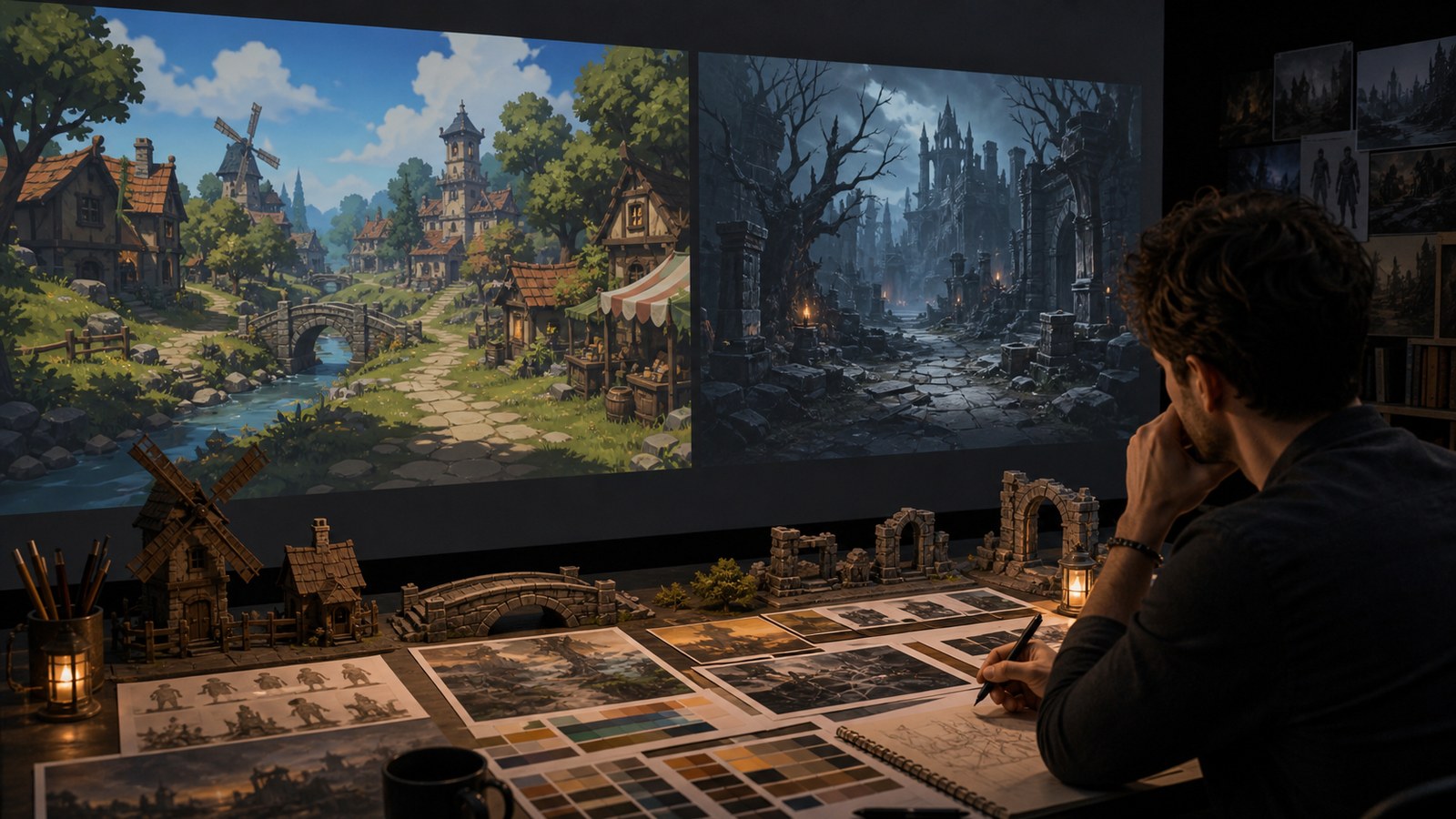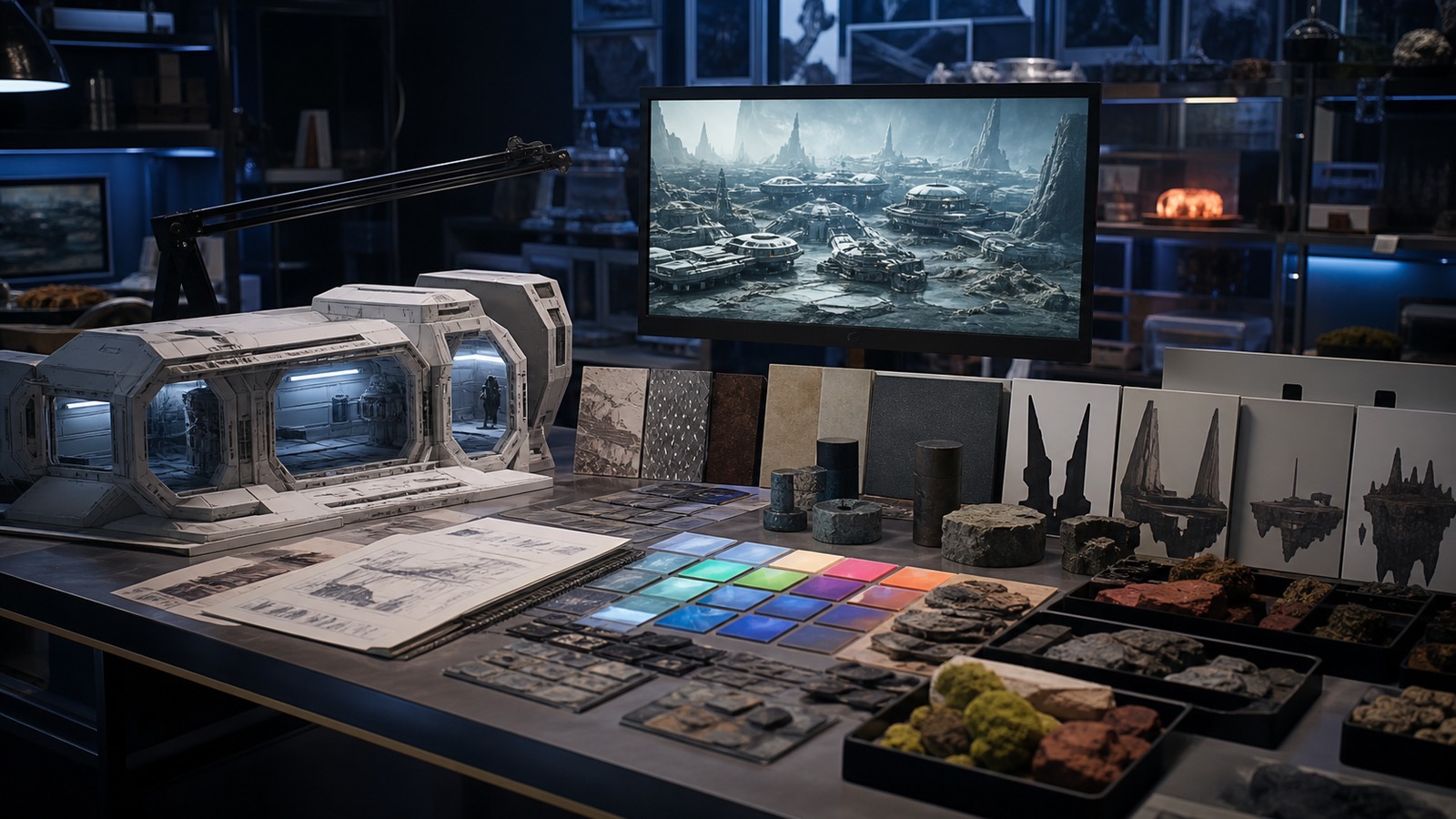
Levels Are Designed Experiences, Not Just Spaces
Level design is the craft of turning space into play. A level can be beautiful, but if players do not understand where to go, what choices matter, how danger works, or why a route feels satisfying, the space is not doing its job. Strong level design combines structure and feeling. It guides without smothering, challenges without confusing, and rewards players for paying attention. Every corridor, arena, shortcut, landmark, overlook, locked door, hidden room, and quiet pause can shape how players think and move. For new game creators, level design can seem mysterious because good levels often feel natural. Players may not notice how carefully a route teaches them, how a sightline sets up a goal, or how a shortcut transforms backtracking into mastery. Learning core techniques makes those invisible decisions easier to plan, test, and improve.
A: Start with one small project that can be finished and reviewed.
A: Add detail after the main structure, scale, and read are working.
A: Use enough to answer form, material, style, and context questions.
A: Helpful feedback points to a clear problem and a possible next change.
A: Keep a must-have list and move extra ideas into a later version.
A: Clarity, lighting, scale, and a view that shows the strongest choices.
A: Use them when they solve a real problem, not because they look impressive.
A: Save versions before big changes and at every stable milestone.
A: Return to the original promise and fix the largest weakness first.
A: It is complete when it meets the goal clearly enough to share, play, display, or learn from.
Start With The Player’s Goal
A level needs a goal the player can understand. The goal may be explicit, such as reach the tower, escape the facility, find the key, or defeat the guardian. It may also be emotional, such as explore the valley, survive the night, or investigate the signal. Without a clear goal, players may move through the space without direction, and even beautiful environments can feel empty.
The goal does not need to reveal every step. In fact, mystery and discovery often make levels stronger. The player simply needs enough intention to begin. A visible landmark, locked gate, distant sound, safe path, or character instruction can create that first pull. Once the player is moving, the level can complicate the route with choices, hazards, and surprises.
Good level design keeps refreshing goals. After one destination is reached, the player should understand the next reason to move. This rhythm prevents confusion and keeps momentum alive.
Block Out Before Decorating
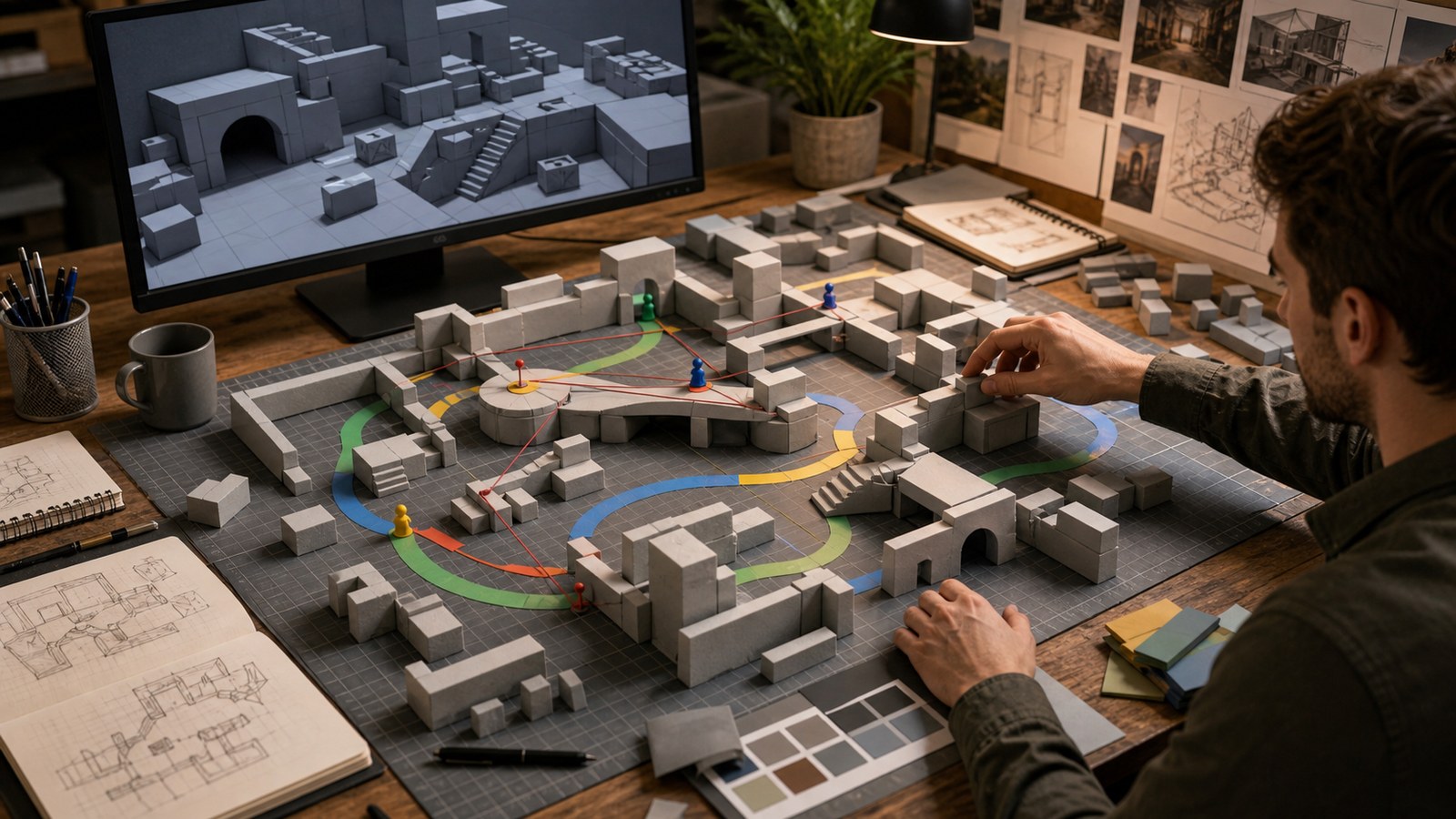
Grayboxing or blockout design uses simple shapes to test the level before final art arrives. This stage is where creators can adjust room size, route flow, jump distance, cover placement, sightlines, pacing, and encounter structure without being distracted by polish. It is one of the most important techniques for new designers because it separates play problems from visual problems.
A rough blockout should be playable as early as possible. Walk through it, time it, fight in it, get lost in it, and invite someone else to try it. If the space is confusing or dull with simple shapes, final textures will not fix the underlying design. Art can enhance a strong layout, but it rarely rescues a weak one. Blockouts also encourage humility. A map that looked brilliant in a sketch may feel too long, too flat, too cramped, or too repetitive in play. Discovering that early is a success, not a failure.
Guide With Composition And Landmarks
Players prefer to feel guided by the world rather than pushed by instructions. Composition helps. A bright doorway at the end of a darker hall, a mountain framed between buildings, a path curving toward a moving object, or a beam of light over a bridge can all guide attention naturally. These cues make navigation feel intuitive.
Landmarks give players memory anchors. A tower, tree, statue, crashed ship, colored roof, or unusual rock shape can help players orient and describe where they are. Landmarks are especially useful in hubs, open areas, and levels with looping routes. They reduce reliance on maps because the world itself becomes readable.
Guidance should be tested with new players. Designers already know where to go, so they often overestimate clarity. Watching someone hesitate is one of the fastest ways to find weak composition.
Shape Pacing Through Contrast
A level with constant intensity becomes exhausting. A level with constant quiet becomes flat. Pacing comes from contrast: narrow and wide, safe and dangerous, simple and complex, bright and dark, fast and slow, high pressure and relief. These changes give the player’s attention a rhythm.
Contrast can happen in layout as well as combat. A tight tunnel can open into a vista. A confusing maze can resolve into a clear overlook. A difficult arena can lead into a quiet supply room. A long climb can end with a shortcut that makes the world feel connected. Each shift changes how the player feels about the space. Designers can sketch a pacing graph before or after building a level. Mark where pressure rises, where the player rests, where discovery happens, and where rewards land. If the graph is flat, the level may need stronger rhythm.
Make Choices Meaningful
Not every fork in a path creates meaningful choice. If two routes are identical, the choice is cosmetic. Meaningful routes differ in risk, reward, skill expression, information, resource cost, or emotional tone. One path might be safer but longer. Another might be dangerous but filled with supplies. A third might reveal story or provide a vantage point.
Choices should be legible enough for players to decide intentionally. If players cannot sense the difference before choosing, the branch may feel random. Environmental cues can suggest what lies ahead: sound, light, enemy silhouettes, terrain type, visible loot, or route width.
Meaningful choice does not require huge branching levels. Even small decisions, such as whether to spend a key, climb for a vantage point, or take a shortcut with risk, can make a level feel more alive.
Use Secrets To Reward Attention
Secrets work best when they are hidden fairly. A cracked wall, unusual sound, suspicious light, repeated pattern, odd camera angle, or visible unreachable item can invite investigation. The player feels clever because the level gave a clue without giving the answer away.
Secrets should match the game’s tone. In a fast action game, a secret may be a quick side room with resources. In an exploration game, it may be a hidden story space. In a puzzle game, it may be an alternate solution or optional challenge. The reward should justify the attention required. Too many secrets can make players suspicious of every wall, which slows pacing. A few well-staged discoveries are often stronger than constant hidden clutter.
Playtest For Behavior, Not Opinions Alone
Player opinions matter, but behavior is more reliable. Watch where players look, where they stop, where they miss clues, where they take damage unfairly, and where they move confidently. A player may say a level was fine while their behavior shows confusion. Another may complain about difficulty when the real issue is poor warning or unclear cover.
Ask focused questions after the playtest. What was your goal? Where did you think the level wanted you to go? Which space do you remember most? What felt unfair? What did you ignore? These answers reveal whether the level communicated its intentions.
Level design improves through iteration. Build, test, observe, adjust, and test again. The best techniques are not magic formulas; they are habits that help designers notice how space becomes play.
Use Sightlines To Create Intent
Sightlines tell players what matters before they arrive. A gap between buildings can frame a tower. A hallway can reveal a locked door. An overlook can show a future arena. These views create intention: the player sees a possibility and begins forming a plan. Without sightlines, levels can feel like disconnected rooms.
Good sightlines do not reveal everything. They show enough to create curiosity, then let the route complicate the journey. This is how levels can feel guided and surprising at the same time.
Design Failure As Information
Failure should teach. If a player misses a jump, gets ambushed, or loses a fight, the level should help them understand why. Maybe the route had a warning, the enemy had an anticipation pose, or the arena offered cover they ignored. When failure contains information, retrying feels fair.
Unclear failure creates frustration. If players do not know what hit them, where to go, or what the level expected, difficulty feels arbitrary. Designers should watch failed attempts closely because they reveal whether the space is communicating.
This is why a level should be played in different moods and at different speeds. A cautious player, a speed-focused player, and a curious player may reveal different problems. Good level design supports more than one reasonable way of moving through the space.
Think In Beats, Not Only Rooms
A level is a sequence of beats: notice the goal, approach the obstacle, learn the mechanic, face pressure, discover a route, earn a reward, rest, and reorient. Rooms matter, but beats describe the player’s experience. Two rooms with the same shape can feel different if their beats are different.
Planning beats helps designers avoid monotony. If three areas in a row all ask players to do the same kind of fighting or navigation, the level may need contrast. A beat map can reveal repetition before testers feel it.
Make The Last Route Feel Smarter Than The First
Many strong levels let players understand the space better by the end than they did at the start. A shortcut opens, a landmark gains meaning, a loop reconnects, or a locked door becomes a return path. The player feels mastery because the space has become mentally smaller and clearer.
This technique works in linear and open levels alike. Even a short mission can end by showing the player an earlier area from a new angle. That recognition makes the level feel designed rather than merely arranged.
Designers can also use temporary labels during internal testing, then remove them later. If testers only understand the level when labels are visible, the layout needs stronger environmental communication. The final version should teach through space, not designer explanation.
Use Rewards To Confirm Good Reading
Rewards are not only prizes; they are feedback. When players follow a subtle clue and find a useful item, shortcut, view, or story detail, the level confirms that attention matters. This teaches players how to read future spaces. A good reward can say, quietly, that the player understood the level’s language.
Rewards should match effort. A difficult hidden route deserves more than a trivial pickup. A tiny optional nook may only need a small resource or charming detail. If rewards feel random, players stop associating observation with payoff. If rewards are consistent, curiosity becomes a habit.
This technique is especially useful for new creators because it links exploration and teaching. The level does not need to lecture players about paying attention. It can simply reward the behavior at the right moment.
The craft becomes easier when creators stop treating levels as containers for content. A level is a sequence of decisions, lessons, emotions, and memories. The geometry matters because it shapes what the player thinks next.
The best level feedback often comes from silence. When testers stop narrating confusion and begin making plans, the space is starting to communicate. Watch where they pause, what they remember, which routes they choose, and whether they blame themselves or the level after failure. Those reactions show whether the layout is teaching, challenging, and rewarding in the right order.
That kind of observation turns level design from guesswork into iteration. Each test gives the designer sharper evidence about pacing, routes, combat pressure, and navigation.
Over time, those observations become a practical design vocabulary the whole team can share together during production.
Let The Blockout Stay Flexible
A blockout is not a contract. It is a question asked in playable form. The designer should be willing to move walls, shorten routes, delete rooms, rotate entrances, add cover, or rebuild an encounter when testing reveals a better version. Flexibility early protects quality later, when changes become more expensive.