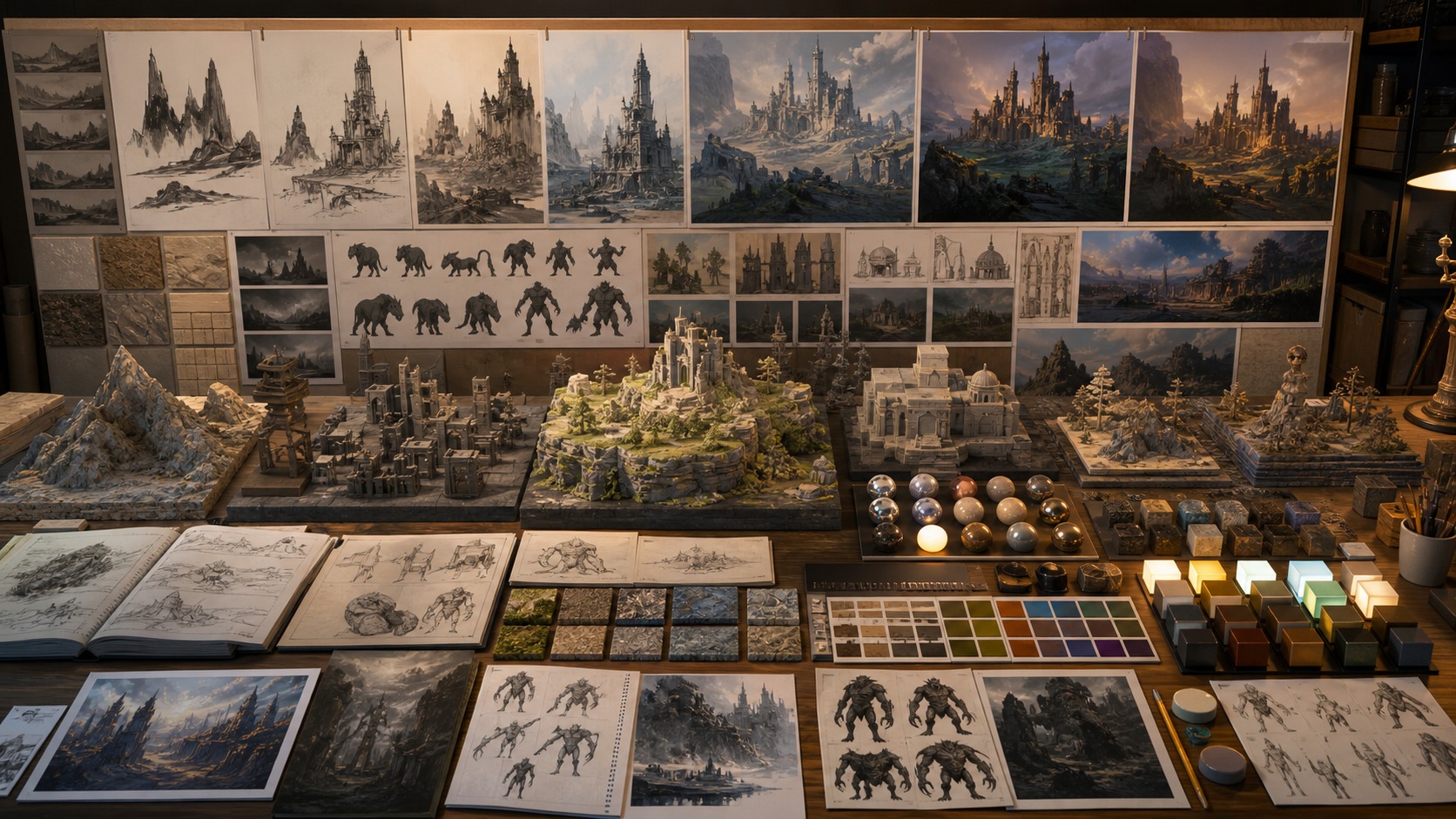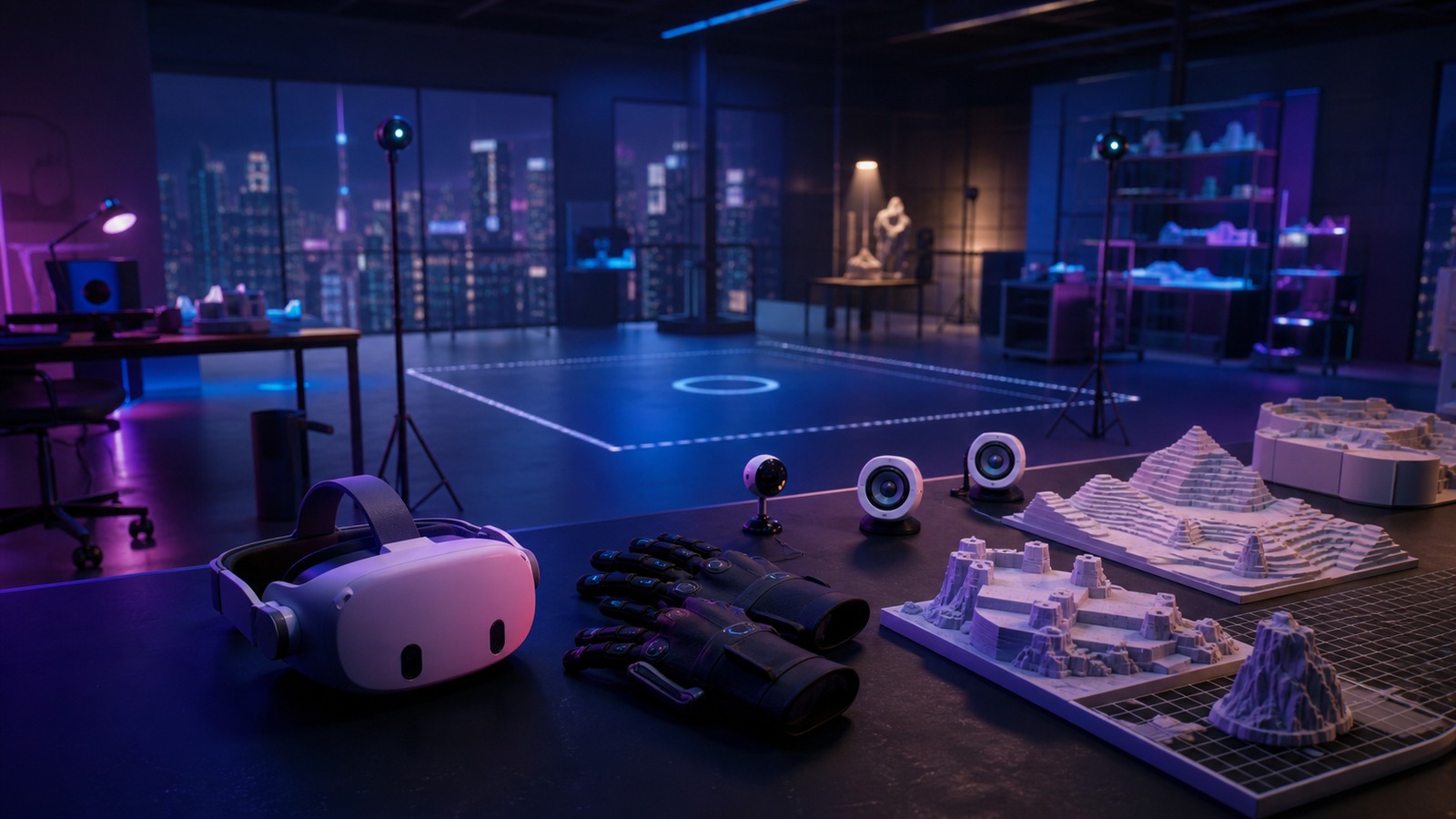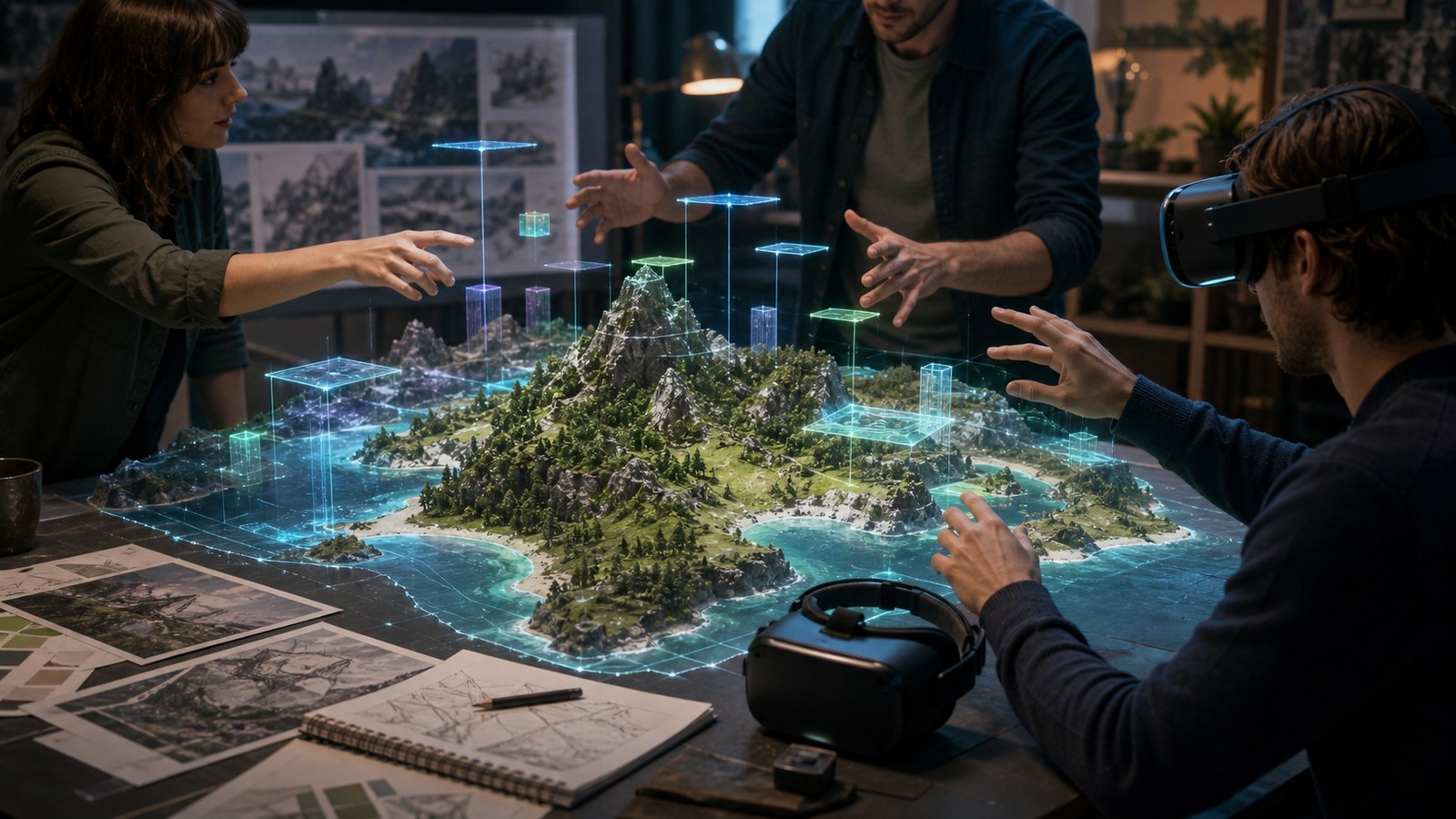
VR Worlds Need Places, Not Just Scenes
Virtual reality worldbuilding asks a different question from traditional environment design: what makes a player want to physically inhabit this digital space? A VR world is not only seen through a camera. It surrounds the player, responds to their gaze, gives them a sense of scale, and invites them to move, reach, listen, and linger. That means worldbuilding must consider curiosity, comfort, routes, landmarks, atmosphere, interaction, and the player’s body as part of the fiction. A beautiful scene may impress for a minute, but an explorable VR place needs reasons to stay. It needs visible destinations, believable transitions, environmental response, quiet details, and spatial stories that reward attention. The goal is not to fill every corner. The goal is to create a world that feels coherent enough to trust and intriguing enough to explore.
A: Start with one small project that can be finished and reviewed.
A: Add detail after the main structure, scale, and read are working.
A: Use enough to answer form, material, style, and context questions.
A: Helpful feedback points to a clear problem and a possible next change.
A: Keep a must-have list and move extra ideas into a later version.
A: Clarity, lighting, scale, and a view that shows the strongest choices.
A: Use them when they solve a real problem, not because they look impressive.
A: Save versions before big changes and at every stable milestone.
A: Return to the original promise and fix the largest weakness first.
A: It is complete when it meets the goal clearly enough to share, play, display, or learn from.
Begin With A Spatial Promise
A VR world should have a spatial promise: the reason this place is worth inhabiting. The promise might be exploring a floating archive, restoring a quiet island, surviving a ruined station, studying magical wildlife, or walking through a memory palace. This promise is not a plot summary. It is the feeling and activity the space offers through the body.
A clear spatial promise guides scale, routes, interaction, and atmosphere. If the world promises careful study, objects should invite inspection. If it promises awe, views and vertical scale need room to breathe. If it promises mystery, routes should reveal information gradually. Without a promise, VR spaces can become impressive but directionless.
The promise should be tested in headset. If players do not behave in ways that match the intended fantasy, the world may need clearer cues or more meaningful interaction.
Create Landmarks Players Can Feel Around Them
Landmarks in VR are not only distant icons. They are spatial anchors players use while turning, moving, and remembering. A tower, glowing tree, suspended machine, waterfall, shrine, or broken ring can help players understand where they are. The landmark should work from inside the world, not only from an overhead map or designer view.
Good landmarks often combine silhouette, sound, light, and route function. Players should be able to say, even casually, that they are near the blue furnace, under the hanging roots, or beside the broken observatory. Those names may never appear in UI, but they form in memory because the place has a strong identity. VR landmarks also need comfort. A destination that requires constant neck craning may create fatigue. Wonder should not depend on physical strain.
Use Interaction To Reveal World Rules
VR worldbuilding becomes convincing when interaction reveals how the world works. A plant that folds when touched, a lantern that responds to proximity, a stone door that vibrates before opening, or a map table that changes with the player’s gesture all teach fiction through action. The player learns by participating.
These interactions do not need to be everywhere. Select a few systems that represent the world’s logic and make them consistent. If ancient machines respond to sound, let that idea appear in several forms. If magical water reacts to hand movement, make it part of puzzles, ambience, and story. Repetition turns interaction into worldbuilding.
When objects only sit in the scene, players become spectators. When objects respond with believable rules, players feel located inside a living system.
Design Routes That Invite Curiosity
Exploration in VR should feel comfortable and self-motivated. Players need visible possibilities: a bridge, cave mouth, lit balcony, distant garden, half-open gate, or sound behind a wall. These cues invite movement without forcing it. The player chooses to investigate because the world has made a promise.
Routes should unfold in layers. Show a destination, hide the exact path, reveal a threshold, reward progress with a new view, then connect back to a known place. This structure helps VR spaces feel explorable without becoming disorienting. It also lets players build mental maps through embodied movement. Optional routes should have purpose. A side room can contain lore, a tactile object, a view, a shortcut, or a small change in atmosphere. Empty optional spaces teach players to stop trusting curiosity.
Give The World Ordinary Life
VR makes small objects feel unusually present. A cup, tool, blanket, hinge, shell, seed, handle, or worn step can become meaningful because the player can lean close and inspect it. Ordinary details make extraordinary worlds feel lived-in. They suggest that the place exists beyond the player’s arrival.
Worldbuilding should include how inhabitants work, rest, travel, repair, celebrate, and hide. Even if no characters appear, the environment can show patterns of life. Paths worn into floors, objects stored at reachable height, repaired structures, and repeated rituals make the space more believable.
The danger is clutter. Ordinary life should be staged, not scattered. VR players notice objects at hand scale, so each inspected detail should support the place’s identity.
Balance Scale With Intimacy
VR can create powerful scale. A huge cavern, towering creature, floating city, or planet-sized machine can feel astonishing because the player’s body senses size. But scale alone is not enough. Large spaces need intimate anchors where players can rest attention and feel connected. A bench, small shrine, hand-held artifact, or reachable control can humanize grandeur.
Alternating scale and intimacy gives exploration rhythm. A narrow passage opens into a vast overlook. A giant structure contains a tiny personal room. A broad island hides a small interactive garden. These contrasts make the world feel richer than constant spectacle. The most memorable VR worlds often let players feel both small and present. They show something larger than the body while still giving the body a meaningful role.
Make Exploration Leave A Trace
Players become more attached to VR worlds when exploration changes something. A door stays open, lights return to a path, a creature reacts differently, a sound layer changes, or a discovered object moves to a central place. The trace does not need to be complex. It simply tells the player that their presence mattered.
Persistent change also helps orientation. A changed space becomes a memory marker. Players know they have been there, not because a checklist says so, but because the world itself has shifted. That is especially valuable in VR, where embodied memory is strong.
Worldbuilding for VR succeeds when players want to remain in the space after the objective is clear. They look around, test objects, revisit views, and form a relationship with the place. That desire is built from comfort, curiosity, response, and coherent atmosphere working together.
Give Exploration A Social Imprint
Even empty VR spaces can feel social when they show how someone used them. A chair pulled toward a window, tools stored near a workbench, a worn path through grass, or offerings beside a shrine suggest inhabitants. These traces make exploration feel like entering a place with memory rather than a set built only for the player.
Social imprint also helps scale. Human-sized objects and habits make strange environments easier to understand. A giant tree village, floating observatory, or underwater archive becomes more believable when players can see how people live, work, and move within it.
Use Distance As A Promise
VR distance can be powerful because players feel it physically. A far tower, glowing cave, drifting island, or moving creature can create curiosity long before the player reaches it. The destination should be visible enough to invite interest and mysterious enough to make the journey feel worthwhile.
The path to that destination should add understanding. Each threshold can reveal a new fact about the world: who built it, what changed, what is dangerous, what is sacred, or what the player can affect. Distance becomes a story structure rather than empty travel.
Designers should also consider what players can ignore. If the world only works when every detail is inspected, exploration becomes pressure. Strong VR worldbuilding lets quick players understand the broad place while giving curious players deeper rewards.
Make Rest Points Part Of The Fiction
Explorable VR worlds need rest points where players can stop, look around, and absorb the space. These might be overlooks, benches, quiet alcoves, sheltered platforms, campfires, or calm rooms. They serve comfort and pacing, but they should also belong to the world’s fiction.
A rest point can show culture, history, or ecology. A lookout may contain worn railings, old carvings, or nesting plants. A pause space becomes more than a break when it also deepens the place. Players remember where they rested because the world rewarded stillness.
Let Optional Discoveries Change Understanding
Optional VR discoveries should do more than fill corners. They can reveal a hidden route, explain a landmark, unlock a sound layer, change an object state, or reframe a previous space. The reward is not only completion; it is a better understanding of the world.
This is especially effective in VR because players feel ownership over discoveries they physically approached. Leaning close, opening a small door, or following a faint sound can make optional content feel personal. The world becomes more inviting when curiosity changes what the player knows.
Scale can support that layered attention. Large forms guide orientation, medium forms invite movement, and hand-scale details reward close inspection. When all three scales work together, the space feels rich without becoming noisy.
Connect Curiosity To Comfort
Curiosity fades quickly if exploration is physically tiring or confusing. A VR world can be full of beautiful destinations, but players will hesitate if routes require awkward turning, repeated crouching, unclear locomotion, or uncomfortable heights. Worldbuilding and comfort need to cooperate. The path to a mystery should feel inviting in the body, not only in the imagination.
Comfort can even become part of the fiction. Rest platforms, handrails, slow lifts, sheltered overlooks, and clear thresholds can make the world feel designed by its inhabitants while helping real players stay oriented. Practical comfort details often become believable world details when they are staged with care.
The best explorable VR spaces make players curious and relaxed enough to follow that curiosity. They do not punish attention with discomfort.
The best VR worldbuilding gives players stories they describe physically: the place where they leaned over the glowing pool, the bridge they crossed slowly, the tiny room they found behind the roots. Embodied memory is the medium’s advantage.
This is why VR worldbuilding benefits from restraint. A designer may be tempted to fill every corner with spectacle, but exploration needs breathable space. Quiet areas let players notice material, scale, sound, and distance. They also make the next strange object or dramatic vista feel earned. The world becomes more inviting when it gives curiosity room to form before asking for another reaction.
Exploration also becomes stronger when the world acknowledges approach. A sound may grow clearer, particles may drift differently, creatures may retreat, or lighting may reveal an unseen route as the player moves closer. These subtle responses make distance feel alive. The destination is no longer just scenery waiting at the end of a path; it is a place reacting to being discovered.
For teams building ambitious spaces, this balance is crucial. Discovery should feel generous, but not exhausting. The player should want to keep looking because each new detail makes the place clearer too.
Design For Revisiting
A VR world becomes more place-like when players want to return. Revisiting can reveal changed light, new sound, opened paths, remembered landmarks, or details that only make sense after later discoveries. The world feels deeper because it supports memory, not just first impressions.