Iconic Characters Are Designed To Be Remembered
An iconic game character rarely becomes memorable by accident. The design usually combines instant readability, emotional clarity, strong silhouette, expressive movement, and a role that players understand through play. Details matter, but they matter most when they support a central idea. A character can be simple and unforgettable if every shape, color, costume choice, prop, and animation beat points in the same direction. Another character can be highly detailed and still disappear from memory if the design lacks focus. Game characters also have to survive conditions that illustration and film characters do not. They must read from gameplay cameras, repeat animations thousands of times, respond to player control, and remain recognizable in menus, thumbnails, fan art, merchandise, and sequels. Crafting an iconic character means designing for memory across all those contexts.
A: Start with one small project that can be finished and reviewed.
A: Add detail after the main structure, scale, and read are working.
A: Use enough to answer form, material, style, and context questions.
A: Helpful feedback points to a clear problem and a possible next change.
A: Keep a must-have list and move extra ideas into a later version.
A: Clarity, lighting, scale, and a view that shows the strongest choices.
A: Use them when they solve a real problem, not because they look impressive.
A: Save versions before big changes and at every stable milestone.
A: Return to the original promise and fix the largest weakness first.
A: It is complete when it meets the goal clearly enough to share, play, display, or learn from.
Begin With The Character’s Core Promise
Before drawing costume details or choosing colors, define the character’s core promise. This is the simple idea players should feel when they see and control the character. The promise might be fearless explorer, reluctant protector, mischievous inventor, haunted warrior, precise hunter, or gentle guide. It should be specific enough to shape decisions but broad enough to leave room for surprise.
A core promise keeps the design from becoming a pile of attractive parts. If the character is a scrappy mechanic, then posture, tools, clothing wear, animation timing, and color accents can all support that identity. If a detail does not serve the promise, it may be decorative noise. Iconic characters usually feel unified because their design decisions point toward the same emotional center.
This promise should also connect to gameplay. A character who moves quickly, solves puzzles, or fights at close range will be experienced through those actions. The design needs to make those actions feel natural. Players remember characters more deeply when visual identity and play behavior reinforce each other.
Make Silhouette The First Test Of Recognition
Silhouette is the fastest memory tool in character design. Players may see a character from behind, in motion, at small size, or through visual effects. If the outline is distinct, recognition survives. If the silhouette depends on tiny costume details, the character may blur into the rest of the cast.
Strong silhouettes often rely on proportion, pose, negative space, and signature objects. A wide hat, unusual weapon angle, oversized gloves, hunched shoulders, flowing scarf, or asymmetrical pack can make the outline memorable. The best choices are not random quirks; they express role and personality. Designers should test silhouettes early and repeatedly. Fill the character in black, shrink the image, rotate it, and compare it with the roster. If the character still reads, the design has a foundation that detail can enhance. If not, polish will only decorate uncertainty.
Use Costume To Reveal Life, Not Just Style
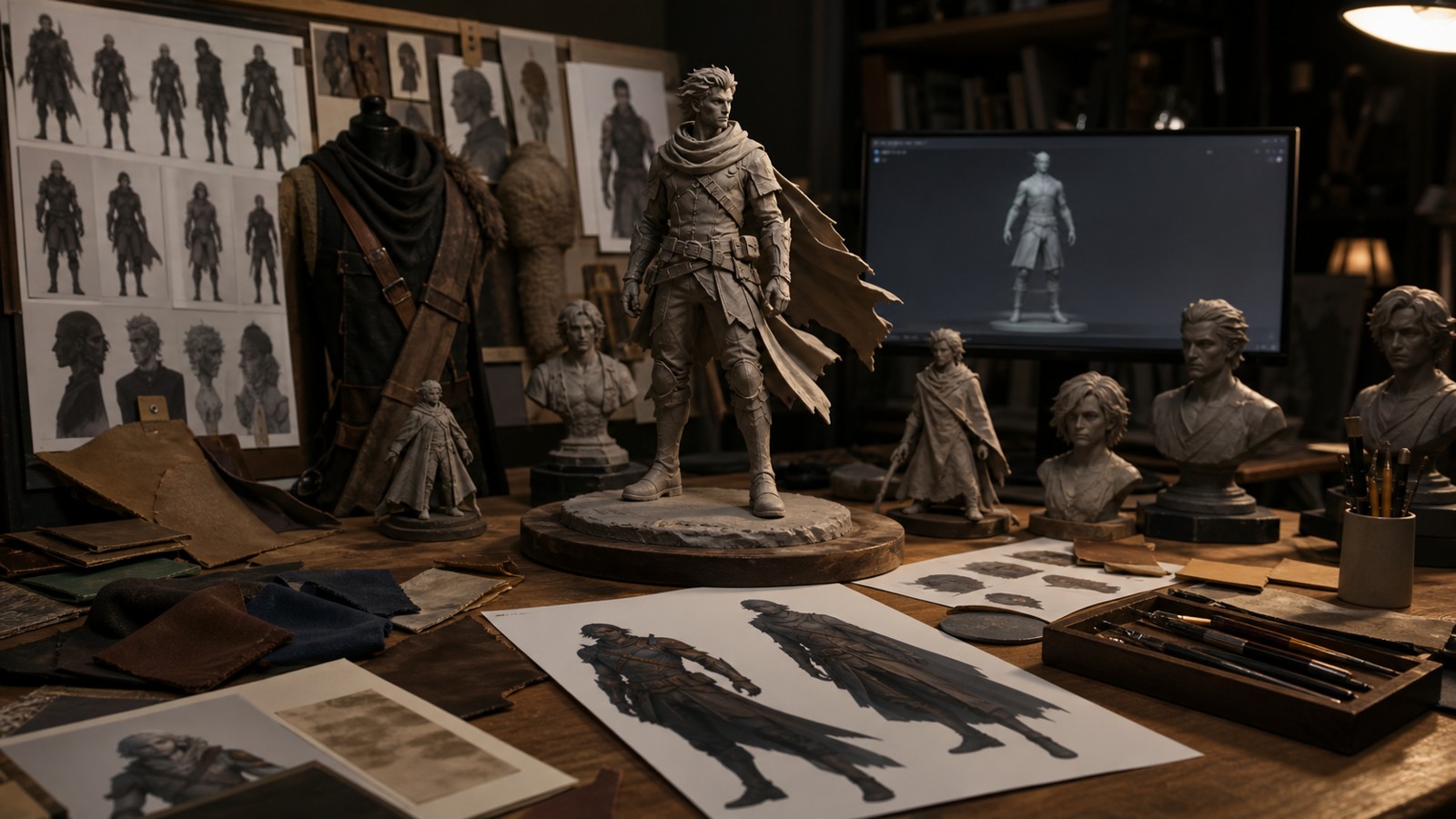
Costume design becomes stronger when it answers practical and emotional questions. Where does this character live? How do they move? What do they protect? What do they value? What have they survived? Clothing, armor, tools, and wear patterns can tell these stories without forcing exposition.
A costume should also respect animation and gameplay readability. Long fabric, dangling accessories, layered armor, and complex hair can look beautiful in concept art but create rigging, clipping, or clarity problems. Iconic design often comes from choosing the few costume elements that matter most and letting them breathe.
Materials can carry meaning too. Polished metal, cracked leather, patched cloth, luminous glass, worn plastic, or ceremonial fabric each suggests a different world and history. When material choices align with character promise, the design feels grounded even in stylized settings.
Let Color Guide Emotion And Attention
Color is one of the easiest parts of a character for players to remember, but it works best with restraint. A focused palette can guide attention to the face, hands, weapon, or power source. Too many competing colors can make the design harder to read, especially during gameplay.
Color also shapes emotional tone. Warm accents can suggest energy, danger, friendliness, or urgency depending on context. Cooler palettes can imply calm, distance, technology, mystery, or melancholy. The important point is consistency. Players should be able to associate the character with a clear color idea across gameplay, UI, and promotional art. Teams should check color against environments and other characters. A great palette can fail if it blends into common backgrounds or duplicates another character’s identity. Iconic color choices are memorable because they are both expressive and practical.
Build Personality Through Movement
Players spend more time watching a character move than studying a static concept sheet. Walk cycles, jumps, attacks, idle shifts, turns, recoveries, and menu poses all contribute to identity. A confident character may occupy space differently from a nervous one. A skilled veteran may waste less motion than a reckless beginner.
Animation can also make simple designs feel rich. A small glance, bounce, weapon adjustment, or hesitation can reveal temperament. These details become familiar through repetition. Players often remember how a character feels to control as much as how the character looks.
Responsiveness matters. If personality animation makes control feel sluggish, the charm will fade. The best game animation balances expression with input clarity, allowing the character to feel alive without getting between the player and the action.
Design For Repetition, Adaptation, And Fan Memory
Iconic characters survive repetition. Players may see the same idle loop, attack, portrait, or victory pose hundreds of times. Designs with clean focal points and satisfying motion tend to age better than designs that rely only on novelty. The character should keep feeling good after the surprise is gone.
They also survive adaptation. A strong character can move into thumbnails, merchandise, fan art, sequels, skins, and promotional images while remaining recognizable. This happens when identity anchors are clear. Fans can draw the character with a few shapes because the design has a memorable structure. Teams should protect those anchors carefully. Sequels and cosmetics can add polish, but they should not bury the original promise. Players form emotional bonds with what they recognize. Evolution works best when it deepens identity rather than replacing it.
Remove Until The Strongest Idea Gets Louder
A useful final pass is subtraction. Remove a pouch, pattern, strap, glow, horn, stripe, or accessory and ask whether the character becomes weaker or clearer. If the design improves when something disappears, that element was competing with the main idea. Iconic characters often feel simple because many weaker choices were cut away.
Subtraction is not the same as blandness. It creates space for the most important traits to register. A sharp silhouette, expressive face, signature prop, and confident color idea can carry more identity than a dozen unfocused decorations.
The goal is a character players can recognize quickly, describe easily, and want to spend time with. When design choices serve memory, emotion, movement, and play, a character has a real chance to become iconic.
Design For The Player’s Hands
Game characters are not only watched; they are controlled. The player feels the character through acceleration, attack timing, turning, jumping, aiming, recovering, and interacting. A design becomes more memorable when the visual idea matches that physical sensation. A heavy guardian should not move like a paper cutout unless the contrast is intentional. A nimble trickster should not be visually burdened by shapes that imply slow weight.
This relationship between look and feel creates trust. Players quickly learn whether a character’s appearance tells the truth about movement. When the design, animation, and controls agree, the character feels coherent before the player can explain why.
Let Imperfections Create Attachment
Iconic characters are often not perfect ideals. A chipped tool, awkward habit, repaired jacket, missing ornament, nervous idle, or stubborn posture can make a design feel personal. These imperfections suggest history and vulnerability, giving players something human to hold onto even in stylized worlds.
The trick is to choose imperfections that sharpen the core promise. Random damage or clutter can muddy the design. A meaningful flaw, however, can create emotional texture. It hints that the character existed before the player arrived and may continue to grow after the current adventure.
Small asymmetries can be especially powerful when they affect animation or silhouette. They make the character easier to recognize and harder to mistake for a generic archetype.
Build A Design That Other People Can Retell
A character becomes iconic partly because players can retell the design to others. They can describe the silhouette, color, weapon, movement, attitude, or memorable visual contradiction in simple words. If a character requires a long explanation before anyone understands the appeal, the design may need a stronger central hook.
This does not mean the character must be simplistic. Rich designs can still have clear retellable anchors. The key is that the first description opens the door, and the deeper details reward longer attention. Fan memory is a useful test. If players can sketch, cosplay, quote, animate, or mod the character while preserving the core identity, the design has traveled beyond the original asset. That kind of portability is one mark of iconic game character design.
Keep The Design Flexible Without Making It Vague
Iconic characters often need to support many contexts: gameplay, dialogue, promotional art, alternate outfits, emotional scenes, action poses, and future updates. Flexibility matters, but a flexible design cannot be vague. The character still needs a core visual spine that survives every adaptation.
That spine might be a silhouette, color relationship, prop, facial structure, movement rhythm, or costume principle. Once the spine is clear, the design can stretch. A formal outfit, battle-damaged version, younger version, or stylized event skin can still feel like the same person because the essential anchors remain.
This is why early clarity saves future work. A character with a strong identity can evolve without losing recognition. A character built from unfocused detail becomes harder to adapt because no one knows what must be protected.
The most memorable designs also leave room for players to form their own attachment. They are specific enough to feel authored, but open enough for players to project emotion, mastery, humor, fear, loyalty, or aspiration onto them. That relationship is what turns a strong design into a lasting character. The asset begins in a concept file, but the icon is completed in the player’s memory through repeated moments of play.
For teams, that means the design process should leave time for recognition tests, animation tests, control feel, and subtraction passes rather than rushing from concept approval to final asset. Iconic design is rarely the result of one perfect sketch. It comes from noticing what people remember, strengthening that signal, and cutting away choices that weaken it. The work is patient, but the result can define an entire game in a single outline, color relationship, or motion.
That is why iconic character design is both artistic and practical. The character has to inspire emotion, but also function under camera limits, animation loops, interface crops, player control, and production change. When a design can carry all of those demands while still feeling simple to remember, it has moved beyond decoration. It has become part of how players understand the game itself.
The final proof is often simple: players recognize the character before they remember the title screen, and they can describe the design without searching for the right words. That kind of memory is built through discipline. It comes from a clear promise, a readable body, expressive motion, useful costume choices, and enough restraint to let the strongest idea stay visible. The result feels inevitable, even when the work behind it was careful.