Vertical Worlds Need More Than Height
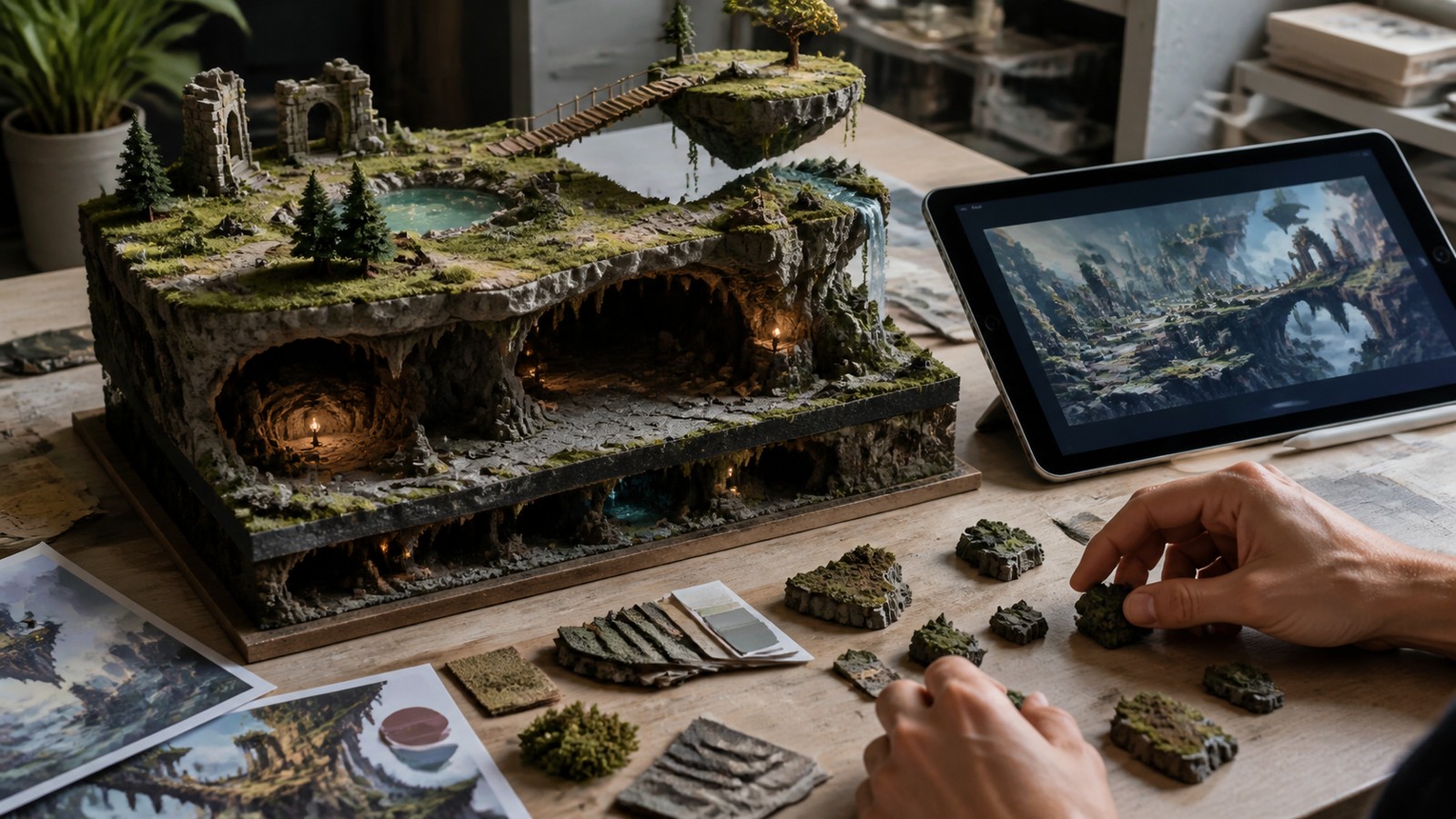
A multi-layered environment is not just a tall map. It is a world where surface paths, underground spaces, interiors, rooftops, cliffs, tunnels, and sky routes relate to one another in ways players can understand. Great layered design gives exploration a sense of depth: a bridge seen from below becomes a future goal, a cave entrance under a village changes how the village feels, and a distant tower becomes both landmark and invitation. For game creators, the challenge is to make vertical complexity feel exciting without becoming confusing. Each layer needs its own purpose, rhythm, and visual language, while still belonging to the same environment. The surface might teach movement and orientation, the underground might create mystery or danger, and the sky layer might offer mastery, speed, or spectacle. When these layers connect cleanly, players feel as if they are discovering a place rather than moving through stacked levels.
A: Start with one small project that can be finished and reviewed.
A: Add detail after the main structure, scale, and read are working.
A: Use enough to answer form, material, style, and context questions.
A: Helpful feedback points to a clear problem and a possible next change.
A: Keep a must-have list and move extra ideas into a later version.
A: Clarity, lighting, scale, and a view that shows the strongest choices.
A: Use them when they solve a real problem, not because they look impressive.
A: Save versions before big changes and at every stable milestone.
A: Return to the original promise and fix the largest weakness first.
A: It is complete when it meets the goal clearly enough to share, play, display, or learn from.
Give Every Layer A Job
The first decision in a layered environment is purpose. A surface layer might support navigation and social life, an underground layer might hold danger and history, and a sky layer might provide speed, spectacle, or mastery. If all three layers offer the same kind of movement and reward, verticality becomes decoration. Players may climb or descend, but the world does not become more interesting.
Purpose also helps production teams make choices. Artists know which materials and silhouettes belong to each layer. Level designers know where to place routes, encounters, and shortcuts. Narrative designers know which stories each layer can carry. The environment becomes easier to discuss because every layer has a role in the experience.
A strong layered world often lets one layer answer a question raised by another. A locked gate on the surface may lead players to search below. A ruined tower seen from underground may become a sky route later. The pleasure comes from realizing that spaces are connected across height, history, and player intention.
Preview Destinations Before They Become Routes
Players enjoy vertical exploration when they can imagine where they are going. A rooftop, cliff path, cavern glow, or floating platform should appear as a promise before it becomes a route. This preview gives players a mental hook. They may not know the exact path yet, but they know the destination is real and worth investigating.
Previewing also prevents layered maps from feeling arbitrary. When players later emerge onto a bridge they saw from the ground, the world feels coherent. When they find themselves beneath a marketplace they visited earlier, the space gains memory. These moments create satisfaction because the player’s understanding grows with movement.
Connect Layers Through Believable Transitions
Transitions are where layered environments often succeed or fail. A ladder, cave mouth, elevator, stairwell, collapsed floor, root tunnel, wind current, or service shaft tells the player how the world is built. If transitions feel random, the layers feel stacked by a designer rather than formed by a place.
Believable transitions do not need realism in a strict sense. A fantasy lift powered by crystals can work if its rules are visually clear. A science-fiction gravity well can work if players learn its behavior safely before relying on it under pressure. The key is consistency. Players should be able to identify transition points and predict their function.
Transitions should also support pacing. A long descent can create tension, while a sudden drop can create surprise. A slow elevator may frame a reveal, while a shortcut ladder may reduce friction on the return trip. Each transition is a small narrative beat as well as a navigation tool.
Design For Camera, Combat, And Traversal Together
Vertical spaces change how the camera behaves, how enemies see the player, and how movement feels. A beautiful layered map can become frustrating if the camera clips into ceilings, if ranged enemies attack from unreadable angles, or if jumps require precision the rest of the game never taught. Multi-layered design must be tested through the player’s actual controls.
Combat height needs particular care. High ground can create advantage, but it should not make encounters unfair. Cover, escape routes, readable silhouettes, and audio cues help players understand threats across levels. If enemies can attack from above or below, players need enough information to react. Traversal should feel consistent with the game’s movement vocabulary. A climbing game can support complex vertical routes because players expect to read surfaces closely. A slower exploration game may need broader paths and clearer transitions. The environment should invite the kind of movement the game can actually deliver well.
Use Materials And Sound To Separate Depth
Layered environments become easier to read when each depth has a sensory identity. The surface might use wind, vegetation, sunlight, and wider color contrast. Underground spaces might rely on damp stone, echo, low-frequency ambience, and tighter light pools. Sky routes might emphasize thin air, open silhouettes, moving clouds, and distant sound. These cues are not cosmetic. They help players remember where they are and what kind of choices belong there. A shift from stone to metal grating can signal infrastructure. A change from open birdsong to muffled dripping can signal descent. A bright rim of sky at the end of a tunnel can pull the player forward without a single written instruction.
Make Shortcuts Change The Player’s Relationship To Space
Shortcuts are one of the great pleasures of layered design. When a player opens a door from below and emerges near an earlier landmark, the world folds together in their mind. The map feels smaller, smarter, and more personal. This is especially powerful in exploration games, dungeons, hubs, and dense urban environments.
The best shortcuts are not merely convenient; they reveal structure. They show that the sewer runs beneath the palace, that rooftops overlook alleys, or that a cave system connects two distant valleys. The player gains practical speed and conceptual understanding at the same time. Shortcuts should usually arrive after effort. If every route is available immediately, the world can feel shapeless. When shortcuts are earned through traversal, puzzle solving, combat, or observation, they become rewards that respect the player’s growing mastery.
Keep Complexity Legible Until The Final Pass
Art dressing can make layered environments beautiful, but it can also hide routes, entrances, ledges, and hazards. Teams should protect readability throughout production. A path that worked in graybox can disappear under foliage, props, fog, decals, or dramatic lighting. The more vertical the map, the more likely visual noise will cover something important.
Regular playtests help catch these problems before they harden into the level. Ask testers to find a destination without guidance, return to a previous landmark, and explain how the layers connect. If they can move but cannot describe the relationship between spaces, the map may need stronger landmarks or cleaner transitions.
A finished multi-layered environment should feel rich but not tangled. Players should sense that more exists above and below them, yet still trust the world to guide them. When surface, underground, and sky routes support one another, verticality becomes a source of wonder rather than confusion.
Respect The Player’s Mental Stack
Players can hold only so much spatial information at once. A layered environment asks them to remember what is above, what is below, where they entered, and which routes may connect later. Designers should introduce that complexity gradually. The first few transitions can be obvious, while later ones become more subtle as the player learns the environment’s language.
A useful rule is to make one layer dominant at a time. The player may see hints of other layers, but the current goal should not require tracking every possibility at once. When the level wants to increase complexity, it can do so after a landmark, rest point, or clear reveal that gives the player a moment to reorient.
Make Layer Changes Feel Emotional
Moving between layers can change more than position. Descent can feel secretive, dangerous, ancient, or intimate. Climbing can feel hopeful, exposed, triumphant, or risky. Crossing from interior to sky can create relief. Dropping from a bright surface into a buried machine space can create unease. These emotional shifts are part of why layered environments feel memorable.
Designers can support those shifts with sound, lighting, scale, and route shape. A tight stairway that opens into a huge cavern creates a different feeling from a smooth elevator into a polished tower. Even if both transitions move the player vertically, their emotional meanings are different.
When layer changes carry mood, players remember them as moments rather than coordinates. The environment becomes a sequence of discoveries, not a diagram.
Use Overlap To Create Recognition
The most satisfying layered spaces often let players recognize one place from another. A player hears the marketplace above while sneaking through a service tunnel. They see a broken skylight from below, then later stand beside it on the roof. They cross a bridge that once looked unreachable from the valley floor. These overlaps make the world feel physically connected.
Overlap should be planned carefully because too much visual density can become confusing. Choose a few meaningful sightlines and sound connections rather than exposing every layer at once. The goal is recognition, not clutter. When players say, “I know where I am,” after emerging from an unexpected route, the layered design is doing more than adding height. It is helping the player build ownership of the space.
Avoid Verticality That Only Adds Travel Time
Not every climb or descent improves a level. Vertical movement becomes frustrating when it adds delay without adding choice, perspective, risk, or reward. A long ladder to a room with nothing meaningful inside feels like padding. A descent through a cave that changes sound, reveals history, and opens a shortcut can feel like discovery.
Every major vertical route should offer at least one design value. It might reveal the map from a new angle, change the player’s tactical position, deepen the story, alter the route back, or create a memorable emotional shift. If a route only consumes time, it should be shortened, repurposed, or removed.
This is especially important in games with repeated traversal. A dramatic climb may work once, but if players must repeat it often, the level needs shortcuts, alternate paths, or faster return options. Layered environments should make the world feel deeper, not slower.
Layered spaces also benefit from production humility. If a route is beautiful but players cannot understand it, the design needs clearer framing. If an underground area has rich lore but no meaningful return path, it may need a shortcut or stronger payoff. If the sky layer looks spectacular but breaks combat or camera behavior, it should be redesigned around the player’s actual experience. Vertical ambition works best when every layer earns its place through movement, mood, and memory.
A helpful final test is to remove the fantasy dressing from the map and look only at movement. If the surface, underground, and sky routes still create anticipation, return paths, changing views, and useful choices, the layered structure is doing real design work. The art can then make that structure beautiful. If the bare movement is dull or confusing, visual polish will only hide the problem for a short time.
The clearest layered maps usually feel simple after they are learned. At first, the player senses depth and mystery. Later, they understand the routes well enough to move with confidence. That transformation from wonder to mastery is the real payoff of surface, underground, and sky design.
That balance rewards attentive exploration.